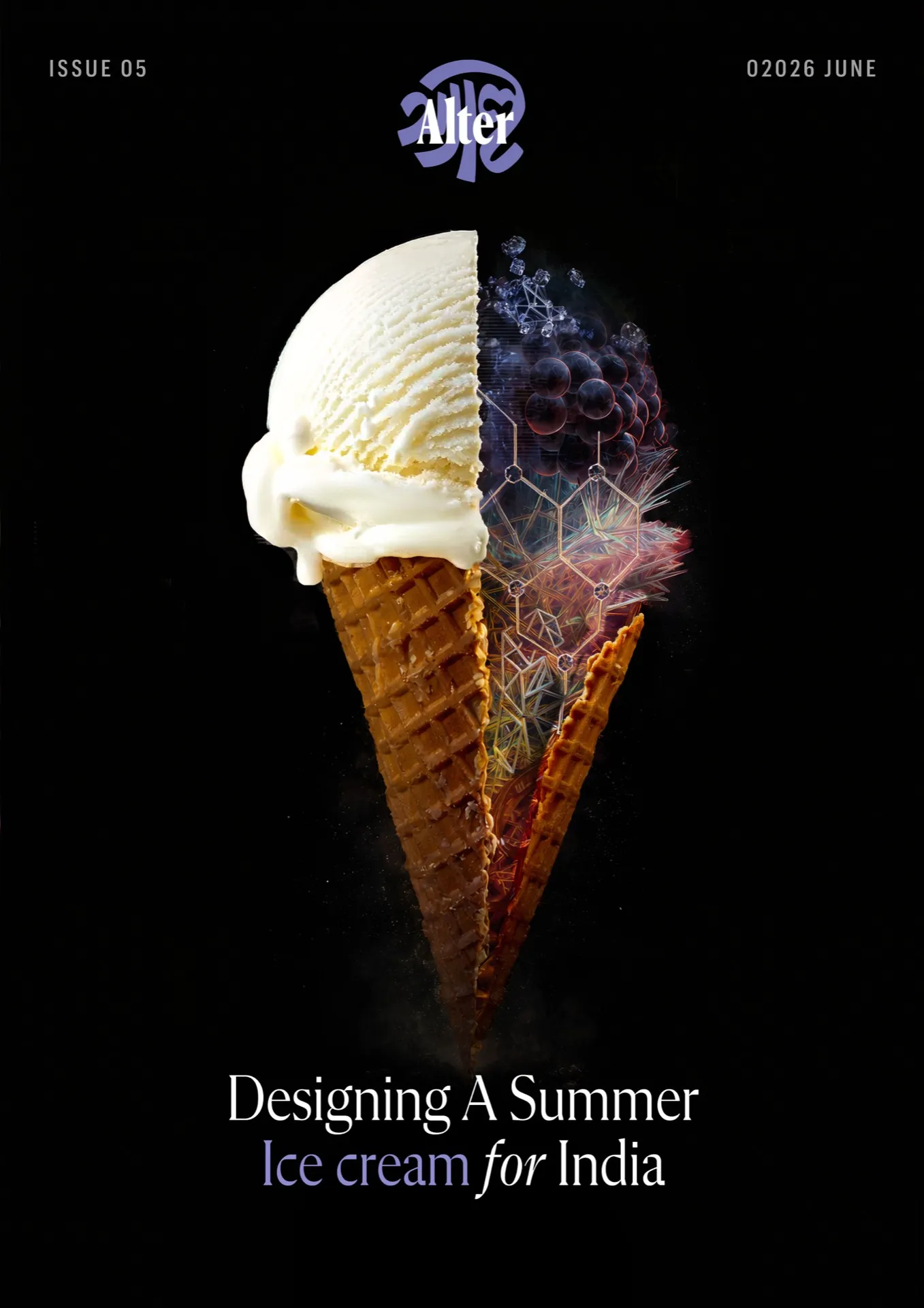
From Mughal kulfi makers to Indian startups — the long effort to build an ice cream that beats the heat
Alter Magazine

Designing a Summer Ice Cream for India
From Mughal kulfi makers to Indian startups — the long effort to build an ice cream that beats the heat
.webp&w=96&q=90&dpl=dpl_4Ddy3NjdpPoVv4q6xKoGwwTGME2t)
Words by Chandhana Sathishkumar02026-06-26
_
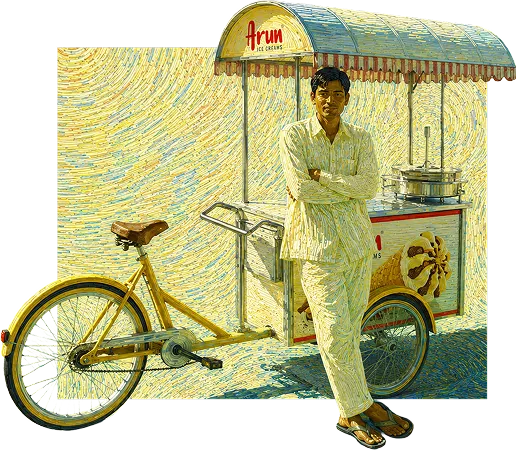
In middle school, I decided to spend my life’s net worth in saved-up coins. The plan pretty much carried itself out when a thallu vandi labelled ‘Arun’ in bright red letters began showing up at my school gate. For many months I bought ice cream after school almost every day, often enough to even have an open tab with the Arun anna. It always went the same way. I hand him a combination of coins totaling ₹10, a vanilla cup peels open and, by the third spoonful, the surface catches a sheen as the sun takes over. By the sixth, a rivulet escapes the rim, and then there is no going back.
.webp&w=3840&q=80&dpl=dpl_4Ddy3NjdpPoVv4q6xKoGwwTGME2t)
There is something really inconvenient about how quickly ice cream melts in the Indian summer. Not because melting is surprising. Of course it melts. The disappointment is how little time it takes to give up. The product sold today feels like it was never designed for the place it lives in.
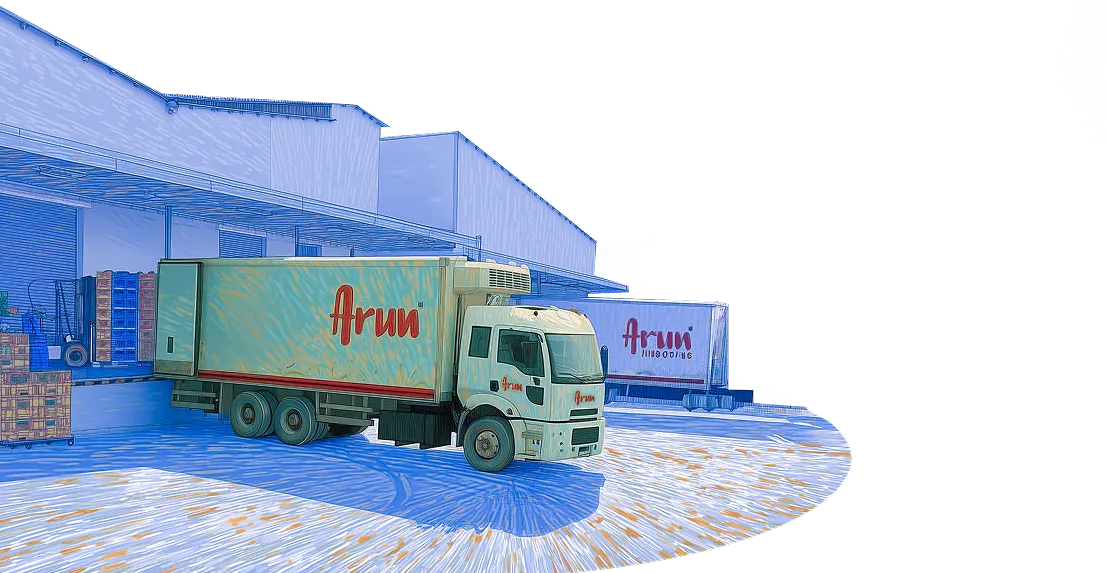
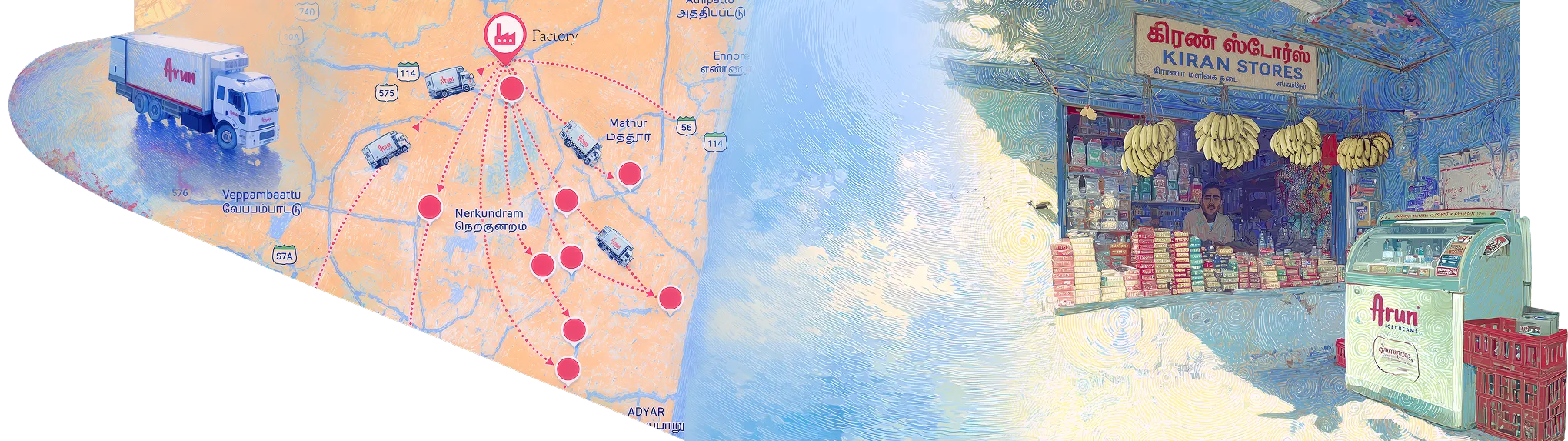
Ice cream here moves through heat, only briefly interrupted by refrigeration. Consider the journey of an ice cream tub. It leaves the factory in a refrigerated truck to reach the distributor, from where it goes to a petti kada1 freezer or a street vendor’s cart, eventually to reach the customer’s home on a bike ride. Each step offers an opportunity for heat to creep in. Repeated cycles degrade its quality even if the product remains frozen.
02026-06-26
Words by Chandhana Sathishkumar
.webp&w=640&q=90&dpl=dpl_4Ddy3NjdpPoVv4q6xKoGwwTGME2t)
Chandhana is a Robinson Fellow at UNC Chapel Hill, studying Chemistry. Her distaste for chocolate and introduction to Adam Smith's pin factory led her down the supply chain and food science behind why that could've happened. And has now culminated in a hobby of understanding what chemical levers can change what food even is
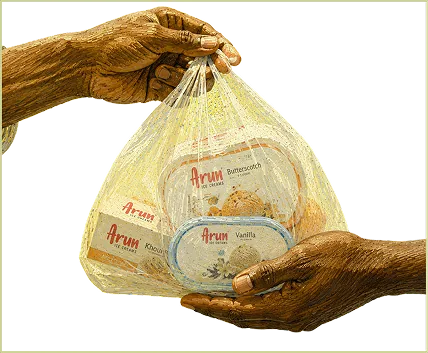
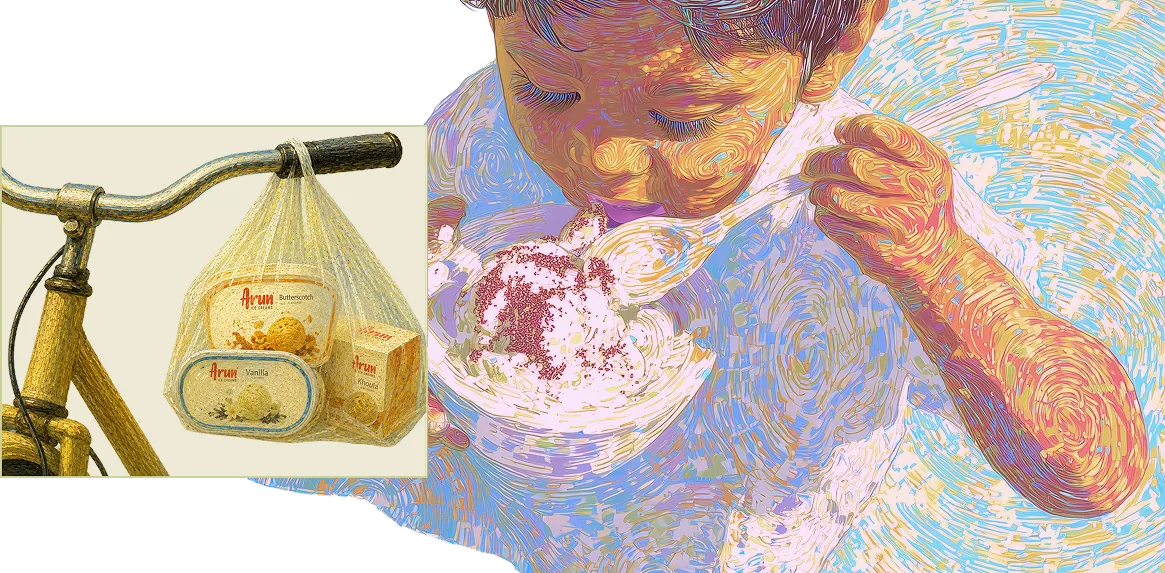
If we take India thermodynamically seriously, what could ice cream look like? To answer that, we have to start with what ice cream actually is.

Ice Cream as a Material
Counter to its name, ice cream isn’t just frozen cream. It’s a multi-phase material held together just long enough. The texture depends on the size and arrangement of these phases.
The first thing holding ice cream together is ice itself, which shares the same lattice structure as regular ice called Ice Ih. For ice cream to feel smooth, these crystals need to stay under about fifty microns, roughly half the thickness of a sheet of paper. When ice cream melts and refreezes, water molecules deposit onto existing crystals. You might have experienced this as a grainy tasting ice cream.
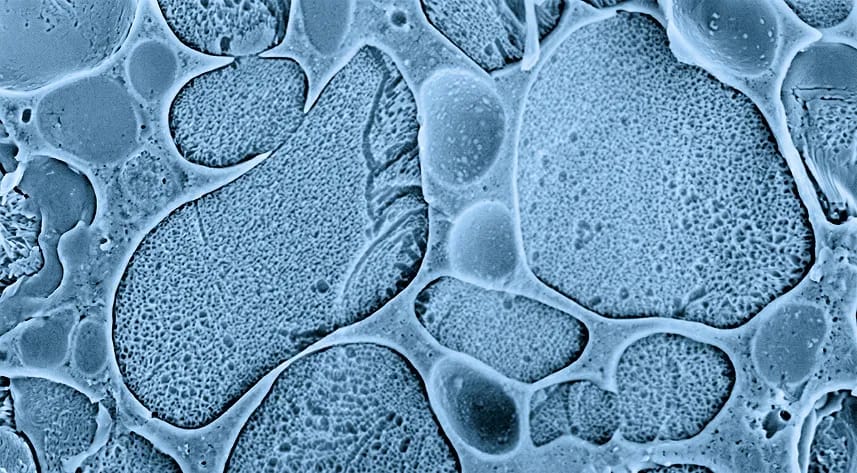
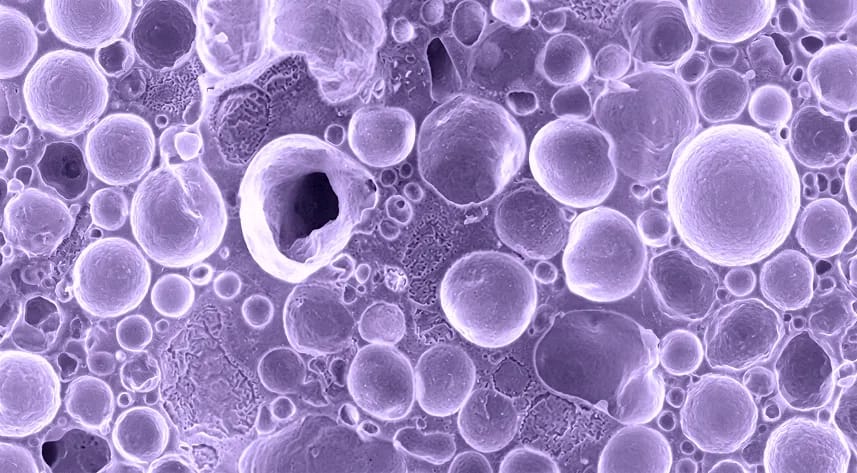
Drag to compare smooth and grainy ice cream. Left: freshly frozen ice cream, showing many small air bubbles (~40 μm) that give ice cream its light, smooth texture. Right: after temperature fluctuations during storage, ice crystals grow larger, creating a coarse, grainy mouthfeel. Scanning electron micrographs courtesy of Douglas Goff, Department of Food Science, University of Guelph.
The second phase doesn’t freeze at all. It is a concentrated sugar solution that stays liquid even below zero. Sugars are excluded from the growing ice and concentrate in the serum, forcing water molecules to reorganize around it rather than lock into place. Without this unfrozen layer, ice cream would freeze into a solid block. The syrup keeps ice cream scoopable.
The third phase is the least obvious one: air. Churning folds air into the mixture and is called overrun, which gives ice cream its lightness. Ice cream can be churned with enough air that nearly half of what you're eating is nothing. The air not only improves mouthfeel and cuts cost per unit volume, but also increases surface area and structural fragility.
The final phase is fat, a mixture of triglycerides from milk or cream that partially crystallizes as the mixture freezes into needle-like structures called β' polymorphs. These fat crystals form a loose network around the air bubbles, keeping them from collapsing and creating the network that gives ice cream its body.
Fat from milk or cream
Concentrated sugar solution
Ice crystals
Air bubbles
Ice cream is a complex mixture of four primary phases. Drag to unpack the structure and see how air, ice, sugar syrup, and fat crystals are distributed by volume.
It is impressive that we figured out this physical structure long before we had microscopes to see ice crystals or crystallography to study their growth. Remove any one of these constraints and you do not get ice cream.
Ice cream melts when one of these factors gives. Usually, it is a combination and not just one mode of failure. Ice crystals absorb heat and liquefy, fat crystals lose structure, air cells collapse, and the foam destabilizes.
As a lover of ice cream but a hater of its melted form, I would try freezing the melted portion of my bowl, hoping to reconstruct what it once was. This never worked and always resulted in either a hard block of ice or an even weirder soup, far from what I would describe as edible, let alone appetizing.
How the world does it
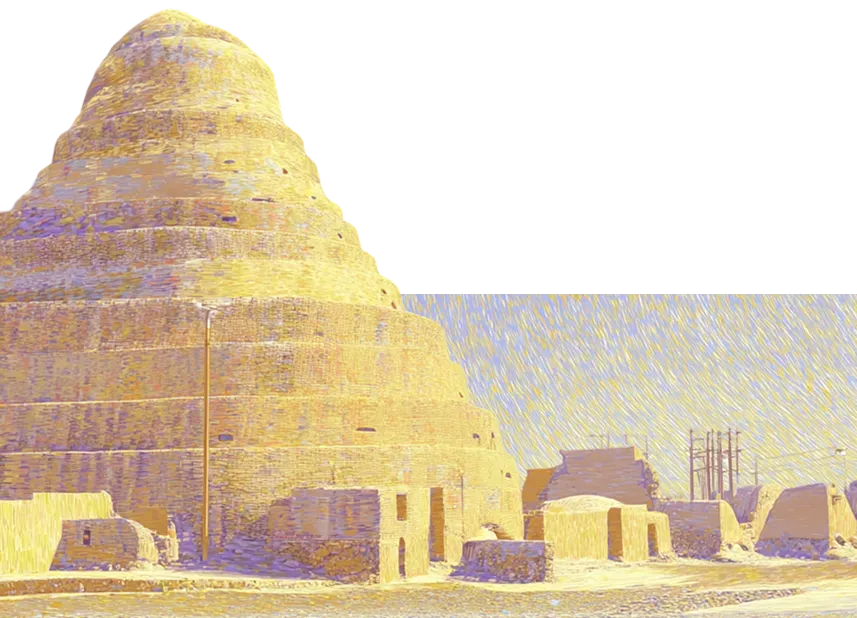
Long before refrigeration, the logistics of cold were already a prestige problem. The Achaemenid Persians were making dessert chilled with snow around 400 BC2. They stored ice year-round in cone-shaped desert structures engineered to beat the heat called yakhchals.
The sharbat tradition3 grew from this and traveled the Silk Road eastward and southward for centuries. By the sixteenth century, it had reached the Mughal court, where the court dispatched riders to carry ice back to the capital for fruit sorbets4. The sharbat reached Europe in part through Muslim Sicily, where sugar culture took root and early frozen drink traditions first arrived on the continent.
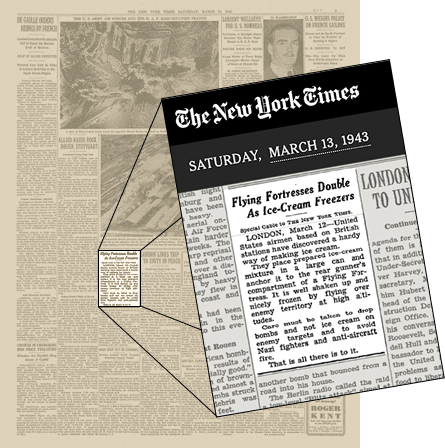

Ice cream continued to travel West, and sometime in the middle of World War Two, American airmen stationed in Europe figured out that if you strapped a container of ice cream mix to the rear gunner's compartment of a Flying Fortress aircraft, the altitude and vibration on a bombing run would do the churning for you. The New York Times reported this in 1943.
Different regions began making it their own as ice cream spread globally. It’s particularly interesting how heat influenced new forms of ice cream in equatorial countries. Thai rolled ice cream—i-tim pad—skips the churn entirely. The mixture gets poured directly onto a metal sheet chilled to below freezing, flash frozen on contact, and then scraped into rolls. Turkish dondurma is the eccentric aunt of ice creams. Made with salep (ground orchid tuber) and mastic (a tree resin) that gives it a chewy, elastic texture that lets vendors stretch it like taffy. It can be cut with a knife and fork, resists melting, and is often hung on meat hooks to prove this point5. The same logic underlies booza, its Levantine cousin, which dates back to the 15th century and is made through pounding and kneading in a freezer drum rather than churning. Both rely on salep as their primary structural agent, which has become a problem because the demand for dondurma has depleted wild orchid populations in Turkey badly enough that the government now bans salep exports6.
56
In Turkey, buying dondurma comes with a show🖱️ Hover to explore
Can't catch me! 😋
In Turkey, buying dondurma comes with a show👇 Tap the cone to start
The classical Indian kulfi originated in 16th-century Delhi during the Mughal era, and it is made by simmering milk until it's thick and caramelized, and frozen without any churning at all. Without any overrun or foam, it has almost nothing in common (structurally) with a scoop of Häagen-Dazs and stays stable longer.
Some newer Indian brands are closely competing with the dondurma in the eccentric ice cream game. A brand called Hocco Ice Cream dropped a barfi-flavored ice cream with the snack industry mogul Haldiram’s and also a modak edition timed with Ganesh Chaturthi. Desserts like barfi ice cream come with a denser composition, making it more stable. The company also extends this thinking to products like Bijlee, which are built to handle temperature fluctuations rather than resist them. (I promise this is not sponsored. As an ice cream veteran since middle school, my expert opinion is that their product strategy is honestly intriguing. And clearly working7.)
The Indian Market
India’s ice cream market generates roughly ₹30,000 crore (~$3.5 billion) annually, with forty percent of that concentrated in the four months from March to June8. Per capita consumption has quadrupled over the past decade or so, from 400ml to 1.6 liters annually9. The market has grown fourfold in the same period, with projections pointing to ₹45,000 crore (~$5.25 billion) within three years, which exceeds the entire GDP of countries like Fiji or Eswatini!10
Market Size
₹30,000 Cr
2026
Projected Market Size
₹45,000 Cr
2029
Highest sales (by month)
March - June
60% of revenue generated
Per capita consumption
4x↑
Two Formulation Regimes
Calling something ice cream is a legal claim. To use the label, a product must be made primarily from dairy and meet minimum requirements for milk fat and milk solids. If the fat comes from vegetable oils instead, it cannot legally be called ice cream and must be sold as a frozen dessert11. The distinction sounds pedantic but reflects an important formulation difference. India's ice cream map splits along a dairy line. The North and West have more concentrated dairy production, so milk fat dominates there and the ice creams are richer. Move South or East, and vegetable fats replace milk fat. They're cheaper and in heat they're more stable. Companies like Kwality Walls have historically sold products with different formulations across regions even when the branding looks identical.
No good rabbit hole ends without some level of sleuthing. To understand ice cream’s cold-chain better, of course I needed to track down as many players as I could in the Indian industry. After enough cold calls, leaders of some of the most active ice cream companies and suppliers in the market agreed to share their stories. The following section is a synthesis of conversations I had with them.
Cold-Chain Infrastructure
India's cold chain is built on small logistics operators with, until recently, almost no real-time visibility into temperature across the journey from factory to shelf. By the account of Varun Sheth of NOTO, India's cold chain ecosystem was fragmented when they launched about seven years ago12. He mentioned that distributors now run their own IoT dashboards. Some brands place independent data loggers inside their shipments. Varun also pointed out that a chest freezer opened upward, lid lifted toward the face, loses far less cold air than one with a door that swings open horizontally, because cold air sinks rather than spills out. Many retail freezers in India are front-opening.
Warehouse design matters as much as temperature targets. If ice cream goes directly from -20°C storage to ambient conditions, the temperature abuse has already begun and a refrigerated truck cannot undo that.
Indian Brands Postponing Melting (Or Freezing, sometimes)
Roli Shrivatsava, Hocco’s VP described this reality as needing to solve for India's constraints and not bypass them. They seemed to think of packaging as a part of the products and created more robust blister packaging for cones and strengthened laminated seals for their Cassata13.
.png&w=1920&q=80&dpl=dpl_4Ddy3NjdpPoVv4q6xKoGwwTGME2t)
NOTO ice cream is built around high-protein, low-sugar formulations. Their earliest formulations had extremely low fat levels due to their position as a healthier option. But in practice, it made the product significantly more sensitive to temperature shocks across the cold chain and created texture problems that consumers noticed. The fix was to increase protein levels and prebiotic fibers. Protein improves water binding and structural stability, partially compensating for reduced fat. Fiber adds body and mouthfeel that helps close the textural gap. Combined with a carefully designed stabilizer system, the product gets close to traditional ice cream texture despite lower sugar and fat.
An elegant solution to ice cream's cold chain problem might be to stop making ice cream altogether. At least in the traditional sense. And instead, to postpone freezing until the very last possible moment.
Soft serve—or softies as they're colloquially known across India—are an entirely distinct product category from ice creams. Manufacturers heat-treat the mix rather than freeze it, which gives it a shelf life of up to nine months at ambient temperatures.
Most people eating a softie don’t realize the difference between it and a scoop out of a freezer. And why would they? The end product looks like ice cream, tastes like ice cream, and is priced like ice cream.
The origin story of soft serve is appropriately accidental. In 1930s America, a broken-down ice cream truck sold its inventory to curious passersby who, unexpectedly, preferred the softer texture14.
Amrit Food is one of India's leading suppliers of ice cream mixes, soft serve mixes, and other specialized dairy-based beverage and dessert products to fast food restaurants. They have supplied soft serve mixes to McDonald's since the mid-1990s. Their customer list now includes Haldiram, IKEA, and DMart. Now they've taken this further by moving their liquid mixes into TetraPak packaging, which eliminates the cold chain requirement entirely on the upstream end. Arnav Bajaj, the Director of Amrit Food, says these commercial machines cost roughly ₹1.5–2.5 lakh ($1800–$3000) at the low end, rising to ₹10–12.5 lakh ($12,000–$15,000) for higher-end units. The upfront cost helps explain why the format remains concentrated in QSRs despite its logistical appeal.
‘If you go to the Thikse Monastery in Ladakh, you'll actually find a soft serve machine there on the first floor. They can store the TetraPak at ambient temperature. Now whenever you want, if there's electricity switched on, turn on the machine, sell ice cream, get it done with’, Arnav explained, clearly pleased.
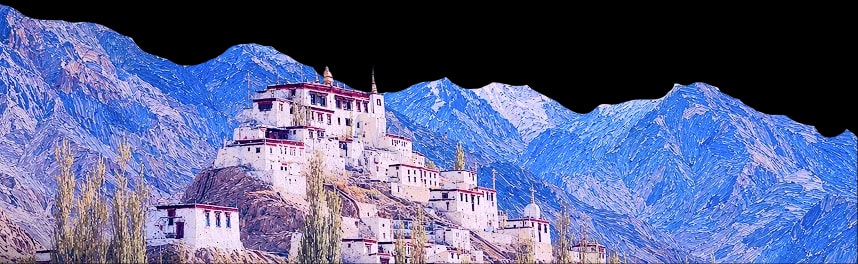
The company’s bet is that heat treatment plus aseptic packaging will extend the shelf life even more15.The only point of transformation is the soft-serve machine at the outlet, which freezes the product at the moment of dispensing. The product doesn't exist as ice cream until the customer orders it.
The economic drag from melty ice cream may be less dramatic than it sounds. One founder I spoke with estimated their heat-related inventory loss at two to three percent on the high side and shared that most of these partially thawed get sold anyway, rather than discarded.
The supply chain problem is going to improve over time, even as temperatures rise due to climate change, eventually paving the way for better cold chain logistics. What is not on a trajectory of getting better is the experience of eating an ice cream bar on a 42°C afternoon. That is a different kind of failure that happens in the hand. One that hardly holds it together long enough to eat.
What Ice Cream Could Be
Heat-stable ice cream is not just a future possibility. Several versions already exist, ranging from reformulated mass-market ice cream engineered in different countries to small-batch premium products in labs.
There is a widespread urban legend that ice cream ever made it to space, and 'astronaut ice cream' has since become a favorite of any space-themed gift shop. Freeze-dried ice cream is made by taking ice cream that is frozen solid and placing it in the freeze-drying machine until more than 98 percent of its water is removed by sublimation16.You end up with a brittle, chalky snack with a shelf life of three years and no cold chain requirement. It doesn't melt because there's no water left to melt. NASA solved the melting problem of ice by creating something that isn't ice cream. The resulting crumbly texture was impractical for spaceflight, and it was never on any space mission to begin with17.
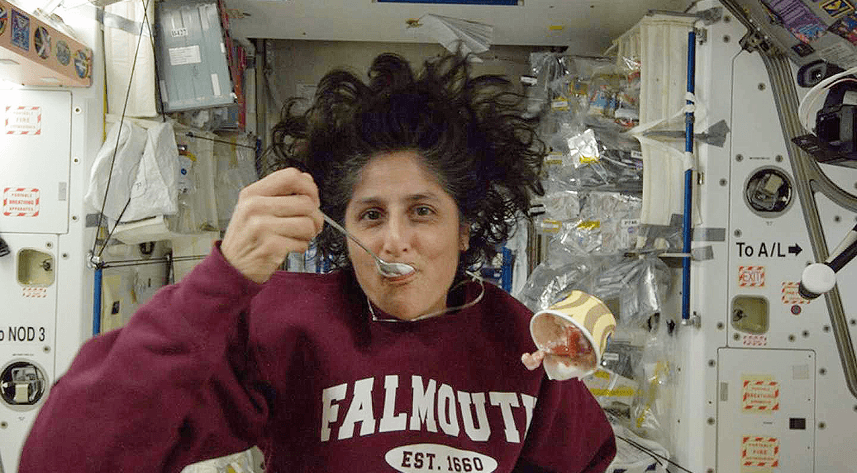
Photo tweeted by Astronaut Sunita Williams aboard the ISS in October 2012, eating chocolate-vanilla swirl ice cream from Blue Bell Creameries, flown up in a powered GLACIER freezer on SpaceX's first NASA-contracted cargo mission.
How to Buy Ice Cream Time
A few levers can preserve the identity of ice cream while bringing it closer to a slow-melting or non-melting form. The most well-established lever is total solids content. Ice cream with low total solids simply doesn't have enough structure-building components to maintain its shape as it warms. This is how kulfi outlasts a standard ice cream bar.
The fat network is another variable. The more interconnected the fat network, the longer the bar holds its shape. If this network is robust enough, it can hold the product's shape even as the ice phase melts away. This is why well-emulsified ice cream retains its form briefly at room temperature before collapsing.
A well-thought stabilizer system can serve as another lever. Hydrocolloids, like carrageenan, guar gum, and locust bean gum, bind water and form gels18. This increases viscosity and slows the diffusion of water to ice crystals, keeping them from growing over time.
Someone Already Solved This
Strawberries and Polyphenols
An answer to non-melting ice cream already exists, and was commercially sold in Japan in six flavors. It arrived by accident when scientists at the Biotherapy Development Research Center in Kanazawa, Japan, had asked a local pastry chef to create a dessert using polyphenols extracted from earthquake-misshapen strawberries that couldn't be sold as fresh fruit19. The chef reported that dairy cream solidified almost instantly when the polyphenol was added. They realized that strawberry polyphenols work as an emulsifier, preventing the oil and water phases of ice cream from separating, helping the frozen product to retain its shape20.
According to the maker, the ice cream held its form for about three hours at 40°C (104°F), while milder commercial batches, made with less polyphenol for taste, kept their shape for around an hour at room temperature. Independent tests by journalists confirmed it resists melting though it still softens over time21.
.webp&w=3840&q=90&dpl=dpl_4Ddy3NjdpPoVv4q6xKoGwwTGME2t)
Bacterial Raincoats
A decade ago, a separate line of research from the Universities of Edinburgh and Dundee identified another natural protein with heat-resistant potential22.The protein, BslA, is produced by Bacillus subtilis and works by adhering to fat droplets and air bubbles, making them more stable in the mixture. A structural trick makes this unusual. BslA exists in two forms: it is soluble in water under normal conditions, but at an air-water or oil-water interface, it flips open a hydrophobic cap23 that drives the formation of an elastic24 film. This transformation stabilizes the fat-air interface in ice cream.
The researchers likened BslA to a ‘bacterial raincoat’. Its film-forming ability stabilizes the interfaces in ice cream, helping it melt more slowly. The protein already has a foothold in the food chain. Bacillus subtilis is used to make fermented staples like natto and meju, giving it a head start on food safety regulations.
Bacillus subtilis biofilm growth. Image credit: Rudjer Boskovic Institute, Zagreb.
Antifreeze Proteins
This class of intervention involves antifreeze proteins, sometimes called ice structuring proteins. These are proteins produced by organisms that have evolved to survive sub-zero environments. Think cold water fish, winter wheat, certain insects, and bacteria. They adsorb directly onto the surfaces of growing ice crystals, halting further growth, while also preventing recrystallization.
Research on ice structuring proteins found they reduced recrystallization rates by 40 and 46 percent at respective concentrations of 0.0025 percent and 0.0037 percent of total protein from cold-acclimated winter wheat grass extract25. The concentrations required are extremely small.
Fish and plant-derived antifreeze proteins scale poorly for food manufacturing. A better direction is to use microbial production in the same way insulin is now produced rather than extracted from animal pancreata. Unilever commercialized this by expressing a type III ISP gene from ocean pout in genetically modified baker's yeast, and the purified protein has been used in low-fat ice cream lines26.
Unilever’s Ice Cream Levers
Unilever has the most commercially serious work happening right now. The company says retail ice cream freezers account for ten percent of its value-chain greenhouse gas footprint and wants to reduce it. Their approach is to run the freezers warmer. The catch is that ordinary ice cream does not stay stable when this happens, so the product has to be reformulated to hold its structure at the warmer temperature.
Unilever tested whether its ice cream could stay stable at -12°C instead of the industry standard -18°C (0°F). Research at its Colworth R&D centre, with the Germany pilots, found that a warmer cabinet cut energy use by around 25 percent.
In November 2023, Unilever granted a free, non-exclusive license to twelve of its reformulation patents. I found no Indian startup or manufacturer that has publicly committed to heat-stable reformulation as a product strategy. The first Indian company to do it stands to define the category.
The category is already moving upmarket. IBEF27describes an Indian ice cream market that now runs from affordable impulse buys to premium artisanal tubs28.Hindustan Unilever (HUL)’s own presentation shows how clearly the category has already split into mass, popular, premium, and super-premium price bands. An ice cream that holds its shape for a few extra minutes but costs a bit more can easily be classified as a premium product.

The sixth spoonful of my ₹10 cup after school did not have to end in surrender. Eating an ice cream doesn’t have to mean risking a sticky mess for millions in India every day. The answer to India's melt problem has clues in a monastery, a Turkish street corner, a Japanese lab, and a Mughal kitchen. Unilever gave twelve reformulation patents away for free.
Someone just needs to make it a reality at every thallu vandi now.
.png&w=828&q=80&dpl=dpl_4Ddy3NjdpPoVv4q6xKoGwwTGME2t)
Footnotes & Acknowledgements
Edited by Fahad Hasin
.jpeg&w=384&q=80&dpl=dpl_4Ddy3NjdpPoVv4q6xKoGwwTGME2t)
Fahad Hasin is a researcher and blogger. His writing is mostly focused on India, covering economics, public policy, and society. But given his love for interdisciplinarity, he ends up wandering well beyond. His work has appeared in India's leading publications like the Hindustan Times, Outlook, Firstpost, and the Wire. He is currently a 1991 Fellow and an Emergent Ventures grantee.

Notes from Team Alter
The Ice cream is an embarrassment of visual riches. Practicing restraint was the hardest thing to do in designing and developing Alter #5. We had a dozen ideas that were shot down (thanks, but no thanks, Adi).
The most arresting visual of ice cream is of the much coveted dessert, perfectly scooped, just softening, glistening on the waffle cone. Dropped. This was a common problem for all of us at Climate Studio. Everyone had felt that pain and we wanted to remind the reader of the agony of loss. Our opening visual is a reminder of that one instance. We all have a dropped ‘cone ice cream’.
The heart of the article is the exploration of ice cream as material. Ice cream is texture before it's flavour, so we set smooth, fresh-churned ice cream micrography against the sad crystallised grain of a refrozen version. We wanted the science to shine, the design to aid relatability and the development to mimic the playfulness of the subject were given. The rest is a story we will talk about at our launch event. Catch Amritha and quiz her magical craft.
The holy grail of design is to create non-derivative products. Everyone is looking at the same references on twitter, instagram, reddit, pinterest, etc. How does one go beyond it? Sparsh challenged us with this idea. And it’s one that’s going to inform our design palette in the coming months. Watch this space for more.
Lastly, the team has been itching to find the right home for ‘pretext’ as a format, and the dondurma (turkish ice cream) sequence turned out to be perfect for it! Readers get to literally chase the ice cream through the text. A mini-game within a long-read, embodying the Alter spirit. Manish brought it to life. We hoped you enjoyed this nugget.
If you enjoyed reading this piece, please do share it. Helps us do better. We're at @altermagindia