Alter Magazine

_
In 1962, Pakistan beat India to space.1
Today, we know India as the nation that landed on the lunar south pole for less than the cost of a Hollywood movie—but, for a brief period, the technological vanguard of South Asia was Karachi, not Delhi or Bangalore.
When Pakistani theoretical physicist Abdus Salam approached President Ayub Khan in 1961 with his vision for a space program, the country had won independence from British colonial rule only fourteen years prior. Pakistan had little industry, only modest universities, and almost no aerospace infrastructure. But Salam, who would later become Pakistan's first Nobel laureate, understood timing better than anyone.2
Just months earlier, President John F. Kennedy had stood before Congress and declared that America would “land a man on the Moon and return him safely to the Earth.”
“We choose to go to the Moon in this decade,” he said, “not because it is easy, but because it is hard.”3
That single promise transformed the National Aeronautics and Space Administration (NASA) from an experimental agency into a machine racing the clock. Designing Apollo meant more than building a giant rocket: NASA had to map the upper atmosphere and ionosphere so precisely that they could predict how much drag a spacecraft would feel, how radio signals would bend across the globe, and how tiny navigation errors would accumulate over dozens of orbits.4
Over the Indian Ocean, NASA’s maps failed. They had a huge blind spot over a vast region, with almost no measurements of high-altitude winds or ionospheric behavior. To understand the implications, imagine trying to sail across the ocean with parts of your map missing, and no idea how the winds behave. Your compass still works, your sails still catch the wind, but the moment you enter the blind spot, you don’t know whether the breeze is nudging you gently forward or shoving you sideways. Apollo faced the same problem in orbit: a few invisible pushes in the wrong direction could turn into a hundred-kilometre miss when it mattered the most.
To fix that, NASA needed a coastal partner on the western edge of the Indian Ocean where it could launch sounding rockets—small, single-use research rockets that carry instruments up to the edge of space for a few minutes before falling back. These would release glowing sodium clouds, turning that empty column of sky into hard data about winds and the upper atmosphere.5
Salam realized that if Pakistan partnered NASA, it could skip a decade of trial-and-error and walk straight into the space age, hand in hand with America. He established the Space and Upper Atmosphere Research Commission (SUPARCO) under the Pakistan Atomic Energy Commission (PAEC) that same year.6
A handful of young engineers, including future SUPARCO chairman Salim Mehmud, were packed off to NASA’s Goddard and Wallops Flight Facility to learn atmospheric sounding, rocket assembly, and tracking instrumentation. When they returned to Karachi, they brought back crates of Nike-Cajun rocket hardware, stacks of technical manuals, and a sense of mission far bigger than their years.
In June 1962, Pakistan's scientists assembled and launched Rehbar-1, a solid-fuel rocket that soared 130 kilometers above the Sonmiani coast, in southern Baluchistan. The name “Rehbar,” meaning “the one who leads the way” in Urdu, was symbolic of the nation’s pioneering status.7

This launch made Pakistan the fourth Asian nation to enter the space race after the USSR, Japan, and Israel.
With continuing American support, Pakistan established a rocket manufacturing plant, launched hypersonic rockets, and laid the groundwork for a civilian satellite program. Pakistani scientists trained at the Goddard Space Flight Center while Apollo astronauts visited Karachi and Lahore. Pakistan launched rockets into space 200 times between 1962 and 1972.8
India’s first sounding rocket would only launch sixteen months after Rehbar-1, but Pakistan's early momentum proved short-lived.
As the 1970s dawned, Islamabad's focus shifted to nuclear ambitions and to countering internal challenges, and the space program lost its privileged status. In 1974, even as India tested its nuclear device, Pakistan amended its constitution to prohibit members of Salam’s religious community, the Ahmadiyya, to refer to themselves as Muslims, and introduced several forms of discrimination against them.9
Salam, unwilling to serve a state that had turned on him, resigned from all official posts and left the country. The exile of the founder and principal advocate of the country’s national space agency hollowed out not only its intellectual leadership but also its ability to attract foreign collaboration, training, and funding. Meanwhile, India leaned into Soviet support by accessing tracking stations, launch opportunities, and propulsion expertise.10 11
The space race between India and Pakistan was effectively over.


The Church That Launched a Space Program
India’s space program began with a bicycle, a church, and a makeshift rocket.
In the early 1960s, Thumba was a quiet fishing village on the outskirts of Thiruvananthapuram. When Vikram Sarabhai, the son of a textile magnate who had turned to physics, first visited Thumba, he realized that its location near the Earth’s magnetic equator made it an ideal spot for atmospheric research.
Sarabhai was an eccentric, with a penchant for treating constraints as invitations. As a Ph.D student, he hauled cosmic-ray equipment 13,000 feet up in Kashmir, transforming a holiday hut into a high-altitude observatory. He had an instinct for occupying spaces that weren’t meant for science and bending them toward his vision.12
Bruno Rossi, a pioneer in X-ray astronomy and space plasma physics, to whose laboratory at the Massachusetts Institute of Technology (MIT) Sarabhai was a frequent visitor, once wrote that Sarabhai had “an almost uncanny capability to absorb and store in his mind a vast amount of experimental and theoretical data,” guided by an intuition that was “almost artistic.” For Sarabhai, Rossi said, “research was an act of love towards nature.”13 14
Rossi’s description serves as the best possible explanation of what followed when Sarabhai first arrived in Thumba. On a Saturday, Sarabhai sought out His Excellency Rev. Dr. Peter Bernard Pereira, the bishop of the local St. Mary Magdalene Church, and asked whether the church property could be transferred for India’s space research.15
The bishop didn’t decide immediately. He asked Sarabhai to return the next morning.
During Sunday Mass, in front of fishermen, families, and children who’d grown up around the church, Bishop Pereira addressed the congregation:
❝
My children, I have a famous scientist with me who wants our church and the place I live for the work of space science and research.
Science seeks truth that enriches human life. The higher level of religion is spirituality.
In short, what Vikram is doing and what I am doing are the same—both science and spirituality seek the Almighty's blessings for human prosperity in mind and body. Children, can we give them God's abode for a scientific mission?
After a brief silence, the congregation replied: Amen.16
Fishermen and their families moved out, some finding new work within the emerging space center’s grounds. The church became the first headquarters; the prayer room was converted into a laboratory, the bishop’s quarters into a design office. The Indian space movement now had its own cathedral. However, it still needed apostles.
Sarabhai was an exceptional talent scout, not because he chased pedigree but because he chased temperament. Thumba’s early team looked less like a government research unit and more like a collection of people who had been pulled out of their ordinary lives and dropped into an improbable mission.
R. Aravamudan, a young engineer from All India Radio, received a cryptic telegram telling him to report to Thumba. He arrived expecting a laboratory. Instead, he found a church vestry, a half-built shed, and Sarabhai explaining orbital mechanics on a chalkboard.17
H.G.S. Murthy, a defence scientist who would become the first director of the Thumba Equatorial Rocket Launching Station (TERLS), left a stable DRDO job to help build a launch range that, at the time, consisted of little more than a church, a beach, and an idea.
Easwar Das, an engineer, worked on early telemetry. His job was to make sure the rockets could tell ground stations what was happening while they flew—voltages, pressures, temperatures.
And finally, there was APJ Abdul Kalam, then an aeronautical engineer sketching wing profiles in notebooks at the Aeronautical Development Establishment. Sarabhai spotted his potential immediately: someone who worked obsessively, learned fast, and was willing to sleep beside a test stand if it meant getting the wiring right. Kalam was recruited because Sarabhai needed someone who could build things with their hands as much as with equations.
The church that Sarabhai appropriated had found its apostles.
Before the first rocket left the ground, the motley group spent months learning how to build one. That training happened once again at NASA’s Wallops Island.
However, the Indian trainees quickly ran into a very real problem: food. The NASA cafeteria served the standard American fare of the 1960s—meat-heavy plates, gravy, and potatoes, which the Indian team, all vegetarians, couldn’t eat. Eventually, they found an elderly woman who ran a tiny kitchen near the base. They taught her how to cook a simple rice-and-vegetable dish with whatever ingredients she could source locally. She didn’t bother remembering its name; she simply called it “the Indian thing,” subsequently a local hit.18
The first launch from Thumba, on November 21, 1963, was a modest affair by global standards. The Nike-Apache sounding rocket was built in the United States, on loan from NASA, and carrying a small French payload to probe the equatorial ionosphere. It was assembled in the church’s nave and nearby classrooms. On launch day, the rocket’s stages were wheeled from the church to the launchpad, some parts carried by hand and some on a bicycle, as curious villagers and international collaborators looked on.
The vehicle climbed to the edge of space, released its instruments into the upper atmosphere, radioed back measurements of winds and electric currents, and then fell into the Arabian Sea. The numbers it returned mattered more to Sarabhai’s team than the altitude itself: they had proved that this improvised station on the magnetic equator could generate critical data the world’s space programs badly needed.
These early years at Thumba set the tone for India’s space program: India would build and learn and improvise its way into the cosmos.
The church at Thumba quickly became a symbol of transformation where faith in science and the promise of a new India found common ground.
As Sarabhai put it: “There are some who question the relevance of space activities in a developing nation. To us, there is no ambiguity of purpose. We do not have the fantasy of competing with the economically advanced nations in the exploration of the Moon or planets. But we must be second to none in applying advanced technologies to the real problems of man and society.”19
American physics found its home in Los Alamos; Indian space technology found its abode in Thumba.
The Early Days of ISRO
The Indian National Committee for Space Research (INCOSPAR) was established in 1962 under the Department of Atomic Energy, with Vikram Sarabhai as its first chair. For a country only fifteen years removed from independence, with scarce resources and competing national priorities, the very act of creating a space programme was audacious.
But it made perfect sense to Jawaharlal Nehru.20
He had spent his political life arguing that scientific temper was not a luxury for rich nations but the foundation of a modern state. “The future belongs to science,” he liked to say, and he meant it literally: weather forecasting, communications, resource mapping, education – all of them would one day depend on satellites.21 22
Nehru backed Sarabhai because he believed that nations that do not control frontier technologies eventually lose control of their futures. The Pakistan-NASA collaboration only sharpened this instinct. If upper-atmosphere science was going to matter geopolitically, India could not afford to sit out.
INCOSPAR’s mandate was to coordinate India’s space research activities at a time when satellite applications were still at an experimental stage worldwide. The first Experimental Satellite Communication Earth Station (ESCES) was set up in Ahmedabad, with the facility supporting both technical development and a training center for Indian and international scientists. The success of ESCES was Sarabhai’s way of answering a simple question: "if you had access to space, what would you actually do with it?"23
In August 1969, INCOSPAR was reorganized as the Indian Space Research Organisation (ISRO). Three years later, the Government of India created the Space Commission and Department of Space (DoS), placing ISRO under direct Prime Ministerial authority. This gave the agency political cover and stable funding, but also demanded results.
When Satish Dhawan took over ISRO following Vikram Sarabhai’s sudden death in December 1971, he inherited an organization that was creative but chaotic. Dhawan himself was not a space insider but a fluid dynamicist and experimental aerodynamicist, director of the Indian Institute of Science in Bangalore, with a Caltech Ph.D and a reputation for quiet rigor. He agreed to lead ISRO on the condition that he could continue at IISc, and that the headquarters of the new Department of Space would be in Bangalore, close to the research and aerospace ecosystem he knew he would need.
Sarabhai’s management style had been patriarchal and informal, with no structured teams or formal systems. Decisions were often taken in drawing rooms and over late-night conversations. The same small set of people hopped between launch operations, applications, and policy. That intimacy was a strength when the organisation was small enough to fit inside a church and a couple of sheds, but it became a bottleneck when the work expanded to multiple centres, rockets, satellites, and international partners.
Dhawan fundamentally restructured ISRO by creating program-based centers with clear leadership and defined responsibilities. Launch vehicles and propulsion were anchored at the Vikram Sarabhai Space Centre in Thiruvananthapuram; satellites and applications at the Space Applications Centre in Ahmedabad; launches themselves at Sriharikota on the Andhra coast; tracking, telemetry, and command at dedicated networks and control facilities. Each center now had a director, a mandate, and its own pipeline of projects, tied together at the top rather than micromanaged from the middle.24
Dhawan’s genius lay in understanding that ISRO needed the autonomy to grow and pursue long-term goals. He established a direct line to the Prime Minister’s office, insulating progress in space from political interference and bureaucratic inertia.
But just as ISRO was finding its footing, the geopolitical landscape shifted. In 1974, India conducted its first nuclear test at Pokhran – code name Smiling Buddha.
The United States and other Western powers imposed sanctions in response, and India was abruptly cut off from critical technology transfers. The newly formed Nuclear Suppliers Group enforced strict controls, and a period of isolation began for ISRO. Projects that once relied on imported components or foreign expertise now had to be built from the ground up.
The denial of cryogenic engine technology in the 1990s was the most visible example of these constraints. In this environment, Dhawan thought that the only path forward for the future of Indian space research was to build a self-reliant organization capable of developing indigenous technology to navigate a world where outside help could no longer be counted on. He insisted that ISRO internalise knowledge, not just hardware: every subsystem had to be understood well enough to be rebuilt domestically if necessary. If something could not be imported, it had to be reverse-engineered conceptually, redesigned for local manufacture, and tested with equipment ISRO itself had built.
The first test of this philosophy was Aryabhata. Built by ISRO and launched by the Soviet Union in 1975, Aryabhata was India’s first satellite and marked the country’s entry into space exploration. The satellite was designed for scientific research in solar physics, aeronomy, and X-ray astronomy.
Although Aryabhata experienced a power failure after five days in orbit, the mission was not judged by its immediate success or failure. The foundations being laid were far more consequential. Under Dhawan, failure became an input rather than an embarrassment, and self-reliance ceased to be a slogan and hardened into a method: understand every subsystem deeply enough that it could be rebuilt at home if the world refused to sell it.
That method matured under Udupi Ramachandra (UR) Rao, who after taking charge as Chairman, Space Commission and Secretary, Department of Space in 1985 shifted ISRO decisively from experimentation to operations.
Rao, who is widely known as the “Father of Indian Satellite Programme,” wanted to apply space technology to India’s developmental challenges. He championed the INSAT (Indian National Satellite) series for communications and the IRS (Indian Remote Sensing) satellites, which evolved from experimental platforms like Bhaskara and APPLE into world-class operational systems. Under his leadership, India's imaging capability improved from around 1 km spatial resolution to better than 1 meter, establishing IRS as a globally recognized brand.
The institutional culture Rao built during the technology denial years proved its worth two decades later under K. Radhakrishnan's leadership when ISRO decided to attempt its most ambitious mission yet — reaching Mars.
The organization drew on decades of experience managing complex projects with limited resources and tight timelines.
By the time K. Radhakrishnan led ISRO through the Mars Orbiter Mission (MOM) in 2014, the organisation had accumulated something rare: decades of embedded know-how across propulsion, navigation, systems integration, mission operations, and failure management. Mangalyaan’s success was not a miracle; it was the logical outcome of an institution trained to do more with less, to design within constraints, and to coordinate hundreds of engineers across multiple centres without losing coherence. That India reached Mars on its first attempt said less about ambition than about process.
But that same process began to reveal its limits. Frugality, which was once considered a badge of honor, was slowly becoming a double-edged sword. Missions were designed to minimise cost; complexity was only a secondary consideration. And it is at this juncture, as India stands poised to move from inspiring underdog to serious spacefaring contender, that the central question emerges: what is the true cost of being cheap?
India’s ability to do more with less has always astonished the rest of the world. The Mars Orbiter Mission cost approximately $74 million, less than the budget of the Hollywood film Gravity. Chandrayaan-3 was developed for about $75 million, compared with the billions spent on comparable NASA missions. India’s annual space budget hovers around $1.7 billion, compared to NASA’s $25 billion and China’s is estimated at $8–11 billion.
This culture of jugaad, or resource improvisation, has become a point of national pride, celebrated in political speeches and media coverage. A “frugality narrative” has become central to India’s space identity. Engineers have developed innovative approaches to mission design, leveraged existing technologies in creative ways, and maintained a laser focus on essential requirements rather than "nice-to-have" capabilities. ISRO’s frugal approach was born out of necessity in the program’s early days, but it has now become the paradigm of India’s space development.
The world has taken notice of India's frugal achievements, but not always with respect. When India successfully reached Mars in 2014, The New York Times published a cartoon showing an Indian farmer with a cow knocking at the door of an "Elite Space Club”—a patronizing image that the newspaper later apologized for after widespread complaints. The cartoon revealed how even India's greatest achievements are viewed through the lens of poverty rather than innovation.25

The New Age of Indian Cosmos
When Elon Musk founded SpaceX in 2002, NASA was already the most storied space agency on earth. But Musk saw what others simply missed: that government programs, for all their triumphs, were slow, expensive, and risk-averse. He believed that only a private company, unburdened by bureaucracy and driven by relentless iteration, could drive down launch costs and make space truly accessible.
A decade and a half later, a similar realization took root in India, half a world away. In 2018, two young ISRO engineers, Pawan Kumar Chandana and Naga Bharath Daka, asked a question that would have sounded impossible just a decade earlier: Why can’t space travel be as easy as commercial air travel, both for people and machines?
Pawan and Bharath were in their twenties when they decided to leave ISRO to start India’s first private rocket launch company. Pawan, a mechanical engineer from IIT Kharagpur, had worked on critical launch vehicle projects at ISRO’s Vikram Sarabhai Space Centre. Bharath, an electronics engineer from IIT Madras, was part of the avionics team for the GSLV Mk III, India’s most powerful rocket. Despite the natural technical fast track that came with their backgrounds, leaving ISRO was not an easy decision. Pawan recalls it as an emotional moment, leaving behind mentors, friends, and the comfort of a stable job.
And yet, interplanetary ambitions hurtled them onwards. Early into the company’s life, Pawan would outline its mission: “If rocket technology becomes more advanced, affordable, and reliable than what it is today, it will open doors for the next big step for humanity, which is expanding out into the cosmos.”26
Skyroot’s first office was a small apartment in Hyderabad. There was no lab, no equipment – just a whiteboard and big dreams (if you’re reminded of Thumba, you’re not the only one). They spent months sketching out designs, cold-emailing investors, talking to ISRO veterans, and brainstorming the regulatory obstacles.
The first breakthrough came when they convinced a handful of former ISRO colleagues to join them, taking pay cuts and working on the promise of equity. Raising capital was a struggle. Indian investors were wary, and most people didn’t understand why private rockets were even needed when ISRO could do the job. In reality, less than 2% of the current global space market is attributed to India. Of the 166-plus successful launches to date in 2025, 110 were from the US, and 95 of them were by SpaceX's Falcon 9. This, at a time when the demand for satellites to be in orbit has risen exponentially, as we rely more and more on space intelligence for smart cars, seamless internet connectivity, and more.
Skyroot pitched to over 100 investors before securing their first big funding from Myntra's Mukesh Bansal, making it the then-largest funding round in the Indian space sector at $1.5 million.
This initial funding allowed Skyroot to move out of its cramped space and set up a modest lab in Hyderabad.
Skyroot’s core insight was not that rockets could be cheaper. That was already obvious. The company’s thesis was more uncomfortable: launch vehicles were slow because they were designed to minimise failure, not to maximise learning. ISRO had built its reputation by avoiding mistakes. A startup had to survive by making them early, cheaply, and often.
That thesis prompted Skyroot to rethink three parts of the launch stack while learning traditional bottlenecks: structure, propulsion, and manufacturing cadence.
Vikram-1 is the first launch vehicle in India, and one of very few globally, whose primary load-bearing structure is entirely carbon-composite rather than aluminium-lithium alloys or steel. The company has spent years developing a small satellite launch vehicle that optimizes for weight. Structural weight dominates far more for small launch vehicles than it does for heavy-lift systems. Every kilogram locked into tanks, fairings, and interstages is a kilogram that cannot be sold as payload. Carbon composites allowed them to push that fraction down aggressively.27
The result is not just a lighter rocket, but a development process with less slack. The vehicle either behaves exactly as predicted, or it fails early. For a startup optimising for fast learning, that trade-off is acceptable.
The final stage of Vikram-1 uses hypergolic liquid propellants—fuels that ignite on contact without needing external ignition systems. The upper stage operates in the most hostile and least forgiving regime of flight by having to deal with extreme thermal cycles and zero tolerance for ignition failures. Ignition systems are a common point of failure. Spark-based igniters introduce extra hardware, timing complexity, and single-point risks, especially after long coast phases when propellants have sloshed, stratified, or cooled unevenly. Hypergolic propellants remove that entire class of failure. When fuel meets oxidiser, combustion is guaranteed. No countdown to ignition. No narrow restart window. No dependency on auxiliary subsystems behaving perfectly in vacuum.
This is the stage where there is no room for hesitation. It fires after long stretches of silence, in deep cold and hard vacuum, when a single misfire can kill the mission outright. By choosing hypergolic propellants, Vikram-1 eliminates an entire category of things that can go wrong. If the valves open and the propellants flow, the engine will light.
Traditional rocket engines are slow to develop because they are modular in the worst way. Hundreds of parts, dozens of suppliers, and interfaces everywhere. Each design iteration propagates delays through the entire chain. By using metal additive manufacturing, Skyroot collapsed this pipeline. Injector heads, cooling channels, manifolds—geometries that were once impossible or prohibitively expensive—became printable as single pieces. Physics and engineering, done like prose and poetry.
In September 2020, Skyroot developed India’s first privately built 3D-printed cryogenic engine in just two days. Later that year, they successfully test-fired a full-scale liquid propulsion engine, RAMAN-I, a first for India's private sector. In 2021, they achieved another milestone with the successful test-firing of the 100% 3D-printed fully cryogenic engine, Dhawan-I—yet another private sector first.28
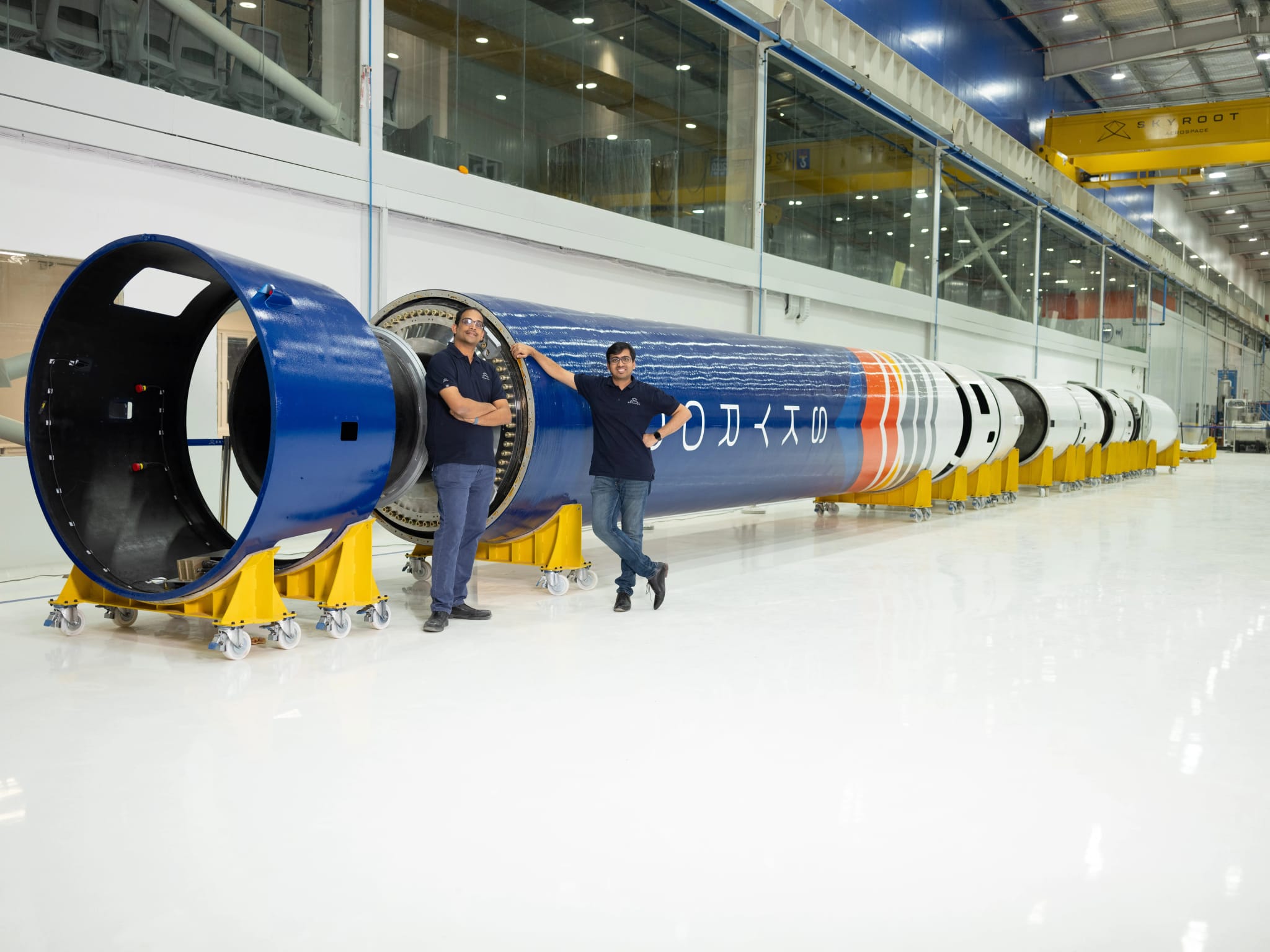
Skyroot HQ in Hyderabad. Bharath (L) and Pawan(R). (Picture credits: Skyroot)
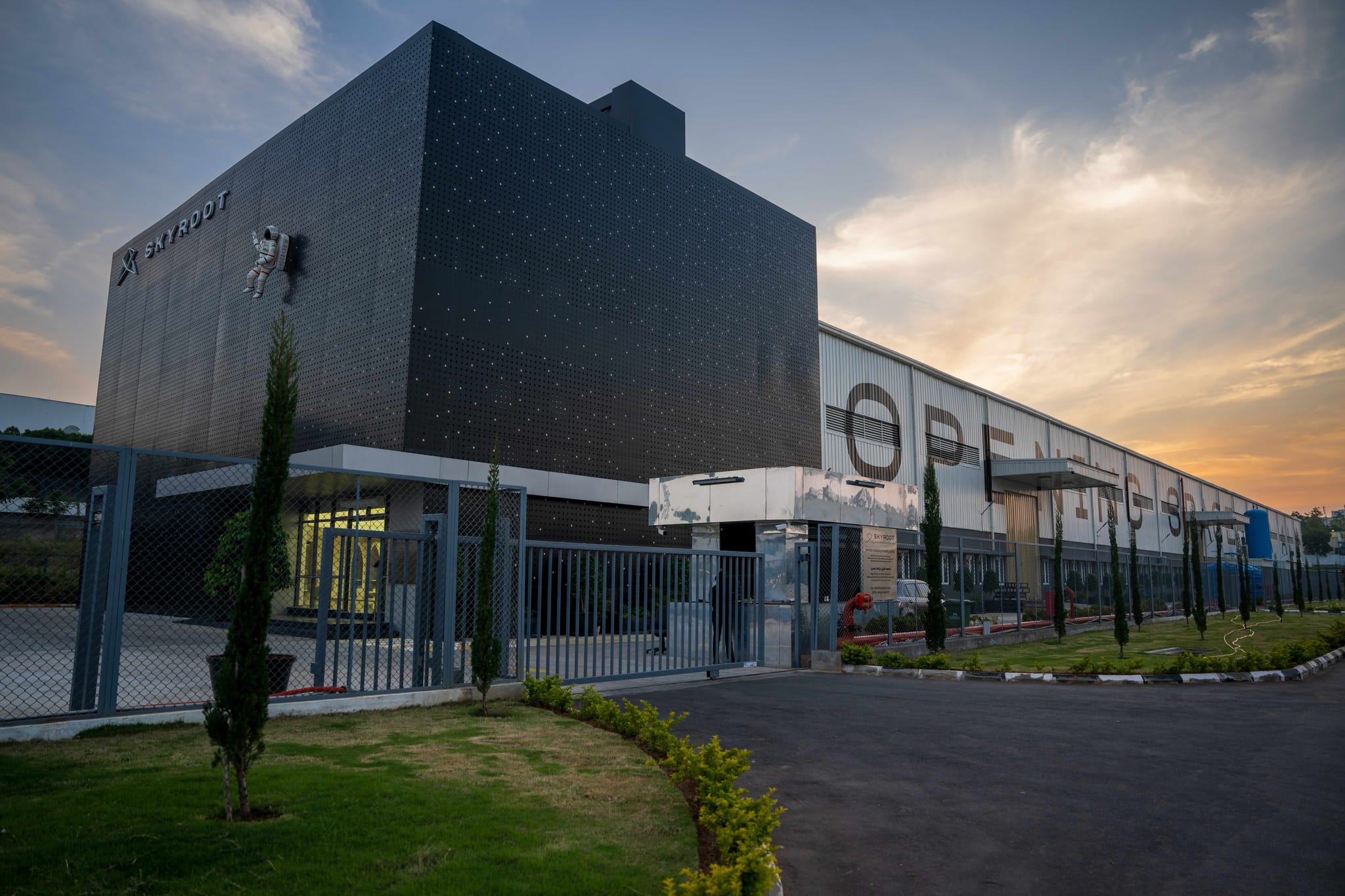
Skyroot Aerospace's Max-Q Campus in Hyderabad. (Picture credits: Skyroot)
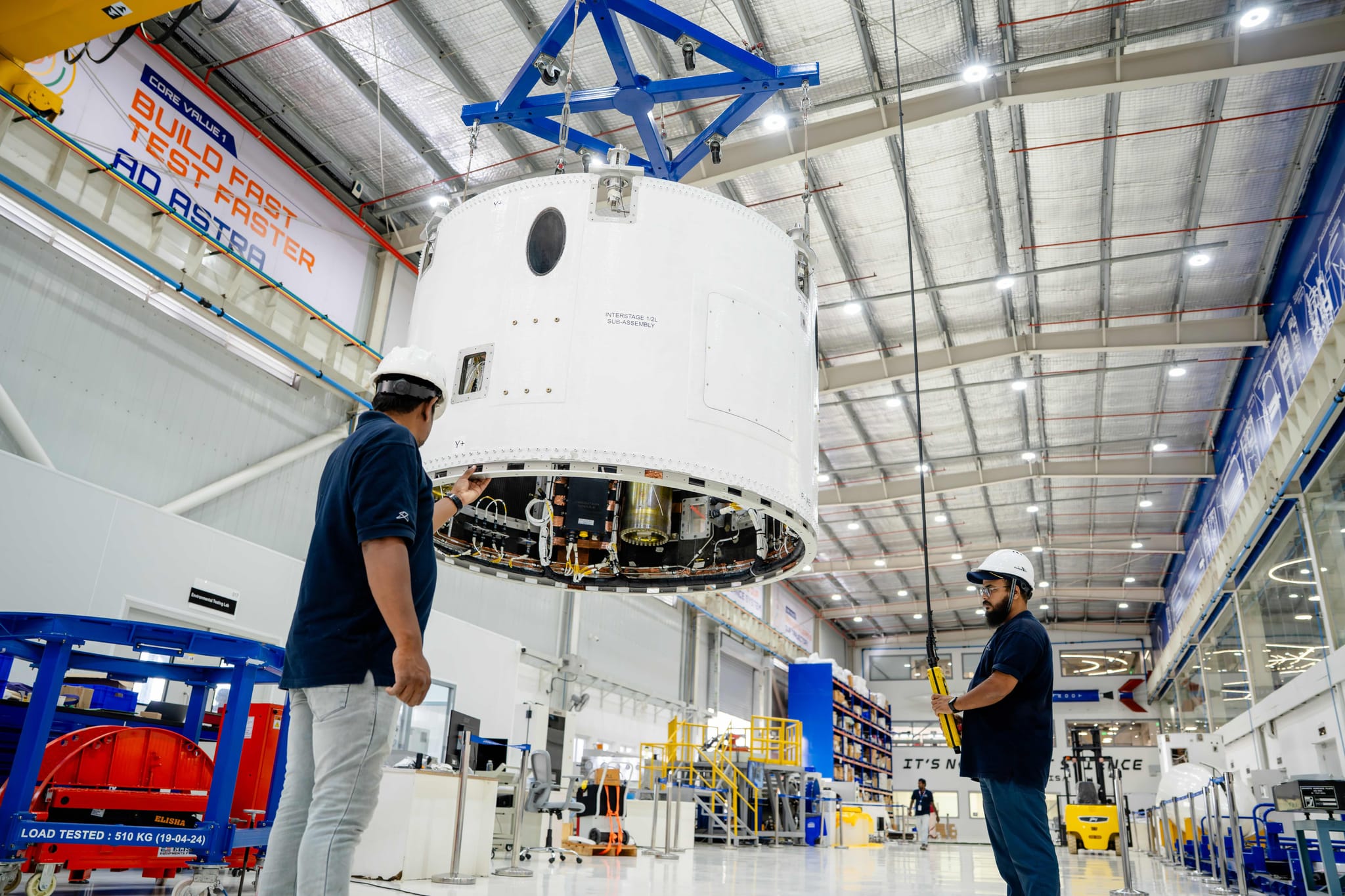
Vikram-1's first stage, Kalam-1200, being moved out of Skyroot Aerospace's facility to the test bed. (Picture credits: Skyroot)
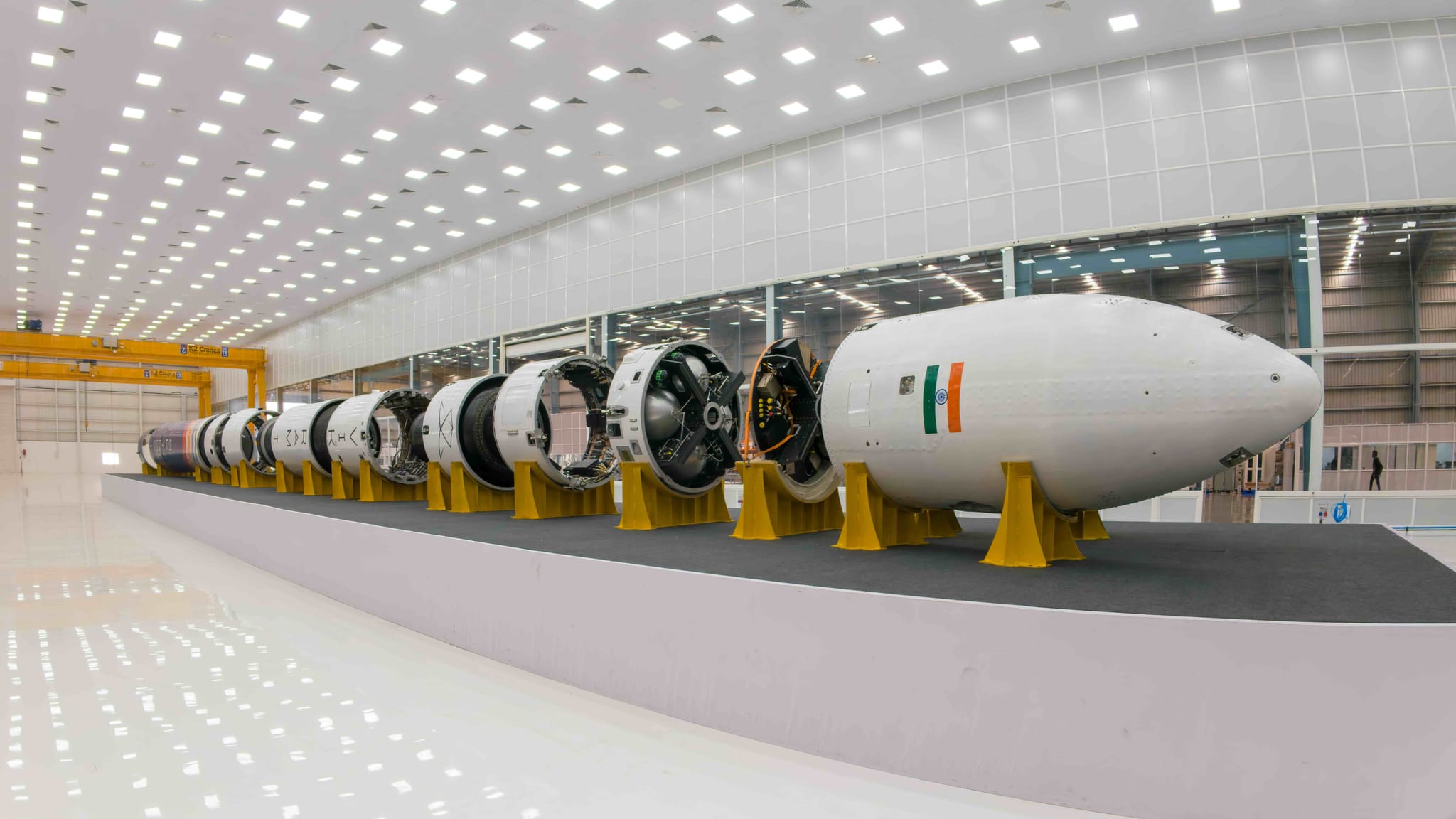
Vikram-1 Launch Vehicle. (Picture credits: Skyroot)
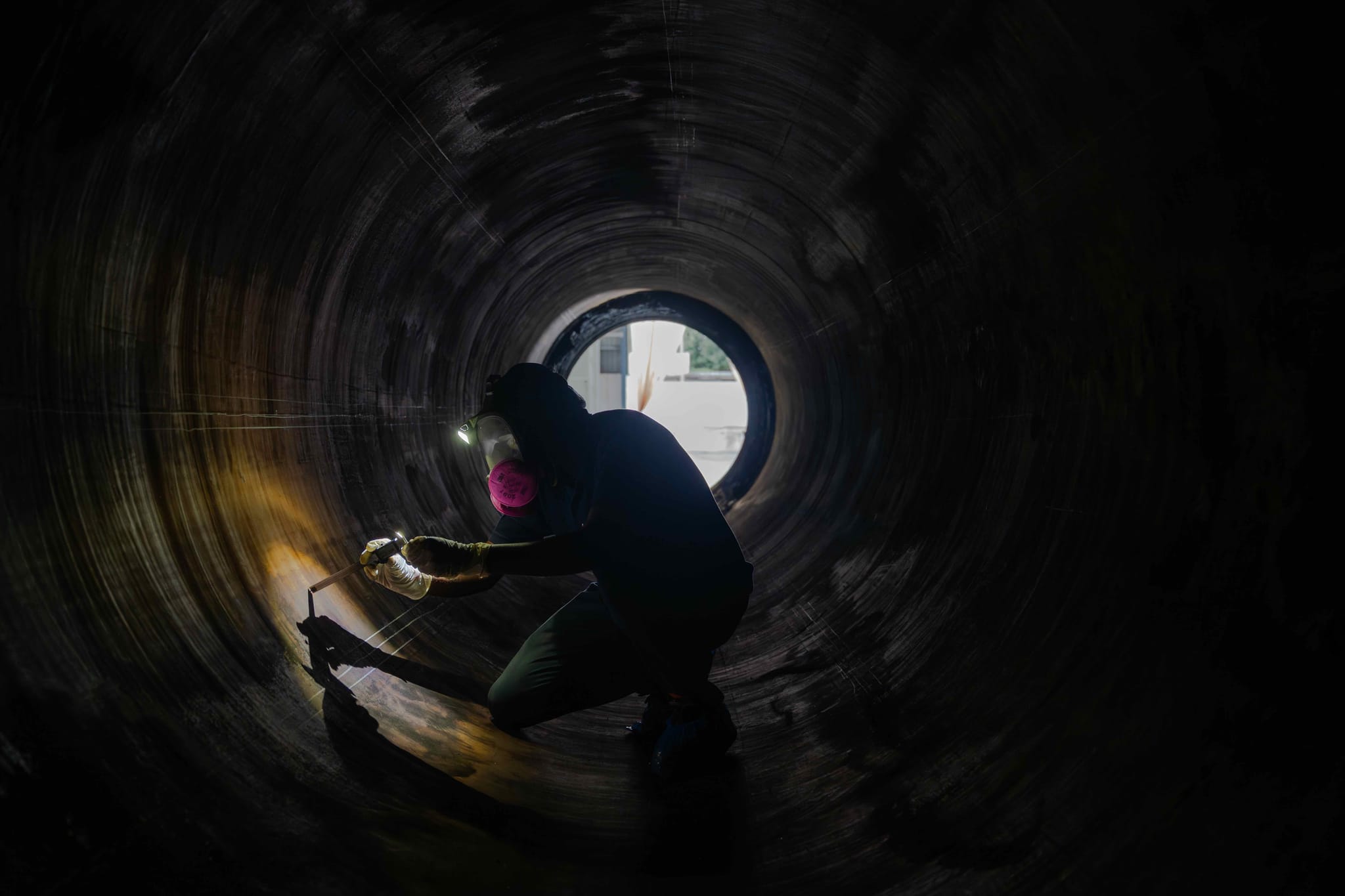
A Skyroot engineer inspecting the Kalam-1200 booster stage post the static fire test. (Picture credits: Skyroot)
Skyroot HQ in Hyderabad. Bharath (L) and Pawan(R). (Picture credits: Skyroot)
Skyroot Aerospace's Max-Q Campus in Hyderabad. (Picture credits: Skyroot)
Vikram-1's first stage, Kalam-1200, being moved out of Skyroot Aerospace's facility to the test bed. (Picture credits: Skyroot)
Vikram-1 Launch Vehicle. (Picture credits: Skyroot)
A Skyroot engineer inspecting the Kalam-1200 booster stage post the static fire test. (Picture credits: Skyroot)
Most people assume that rocket technology, while complex, should be relatively accessible by now—after all, we live in an era of frequent satellite launches and reusable rockets. But the reality is very different. Apart from a handful of global players like SpaceX, Rocket Lab, and Blue Origin, Skyroot is one of the very few private companies in the world to have successfully built and launched a rocket into space.
When Skyroot began, it was actually illegal for private companies to launch rockets from Indian soil.29
Through persistent effort, technical excellence, and strategic engagement with policymakers, Skyroot not only overcame these obstacles but also helped shape the regulatory landscape itself, paving the way for a new generation of private space ventures.
Pixxel is now one of the fastest-growing space-tech companies in India. Its founders, Awais Ahmed and Kshitij Khandelwal, were studying mathematics and electrical engineering respectively, at BITS Pilani, when they realized that the world’s satellite data wasn’t good enough for the problems we face. Most Earth observation satellites could show you what was happening, but not why. Threats like climate change, crop disease, and pollution often remain invisible until it’s too late.
Awais and Kshitij started out as two friends who enjoyed playing FIFA together and debating space colonization between goals. Awais grew up in Chikmaglur, Karnataka, without access to the internet until 8th grade. As a kid, he wanted to be an astronaut, and religiously consumed encyclopedias to feed his curiosity. Kshitij, on the other hand, grew up in a small town in Maharashtra called Amravati, with a passion for understanding complex systems and never missing an ISRO launch on TV.30
At Pilani, Awais and Kshitij joined Team Anant, the student satellite initiative mentored by ISRO scientists. Here, they learned what it took to design, build, and test a real satellite. Team Anant is where they first delved deeper into hyperspectral imaging and its potential to visualise more than existing imaging techniques. They began researching hyperspectral technology that captures hundreds of spectral bands, revealing details about crop health, water quality, and pollution that normal satellites miss. They realized that no one was offering this data commercially at the resolution and frequency the world needed.
Awais had a 60-year plan for the new company that he would go on to start with Kshitij—from pushing out satellites in Earth orbit to finally mining asteroids. The Sarda family from Nagpur wrote the first cheque for Pixxel. They are angel investors in core science and deep tech startups. As they handed over the cheque to two 19-year-olds, the Sardas reserved the right to name their first satellite.
The very first tech demonstration satellite was Anand, named in memory of a former intern who had passed away. Anand was meant to prove that their technology could work in orbit and deliver useful data to early customers.
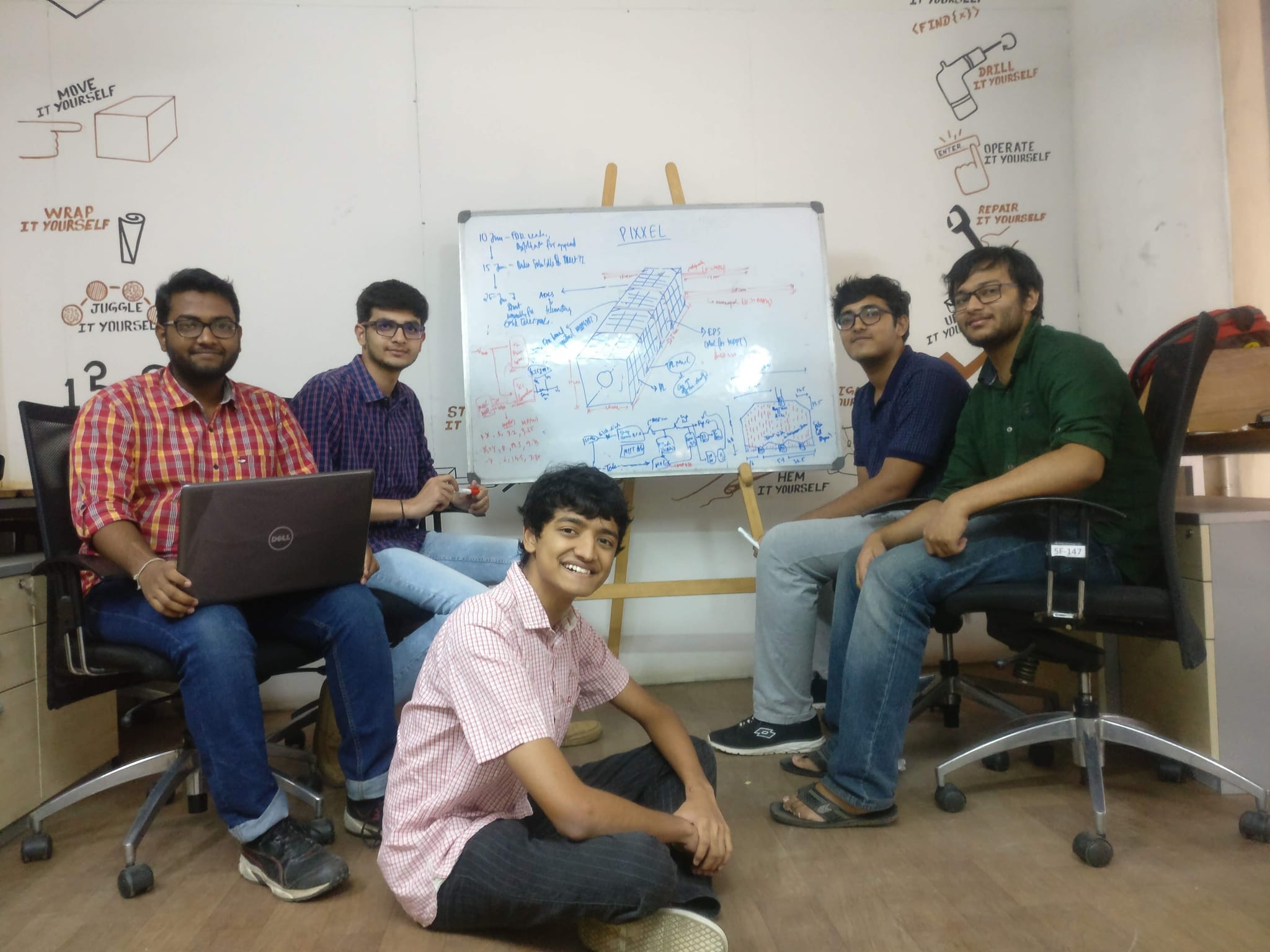
Early days at Pixxel, sketching what would become real. (Picture credits: Pixxel)
%2520(1).png&w=2048&q=80&dpl=dpl_4Ddy3NjdpPoVv4q6xKoGwwTGME2t)
Pixxel Spacecraft Manufacturing Facility in Bengaluru. (Picture credits: Pixxel)
.jpg&w=2048&q=80&dpl=dpl_4Ddy3NjdpPoVv4q6xKoGwwTGME2t)
Pixxel team at Anand hyperspectral satellite launch event. (Picture credits: Pixxel)
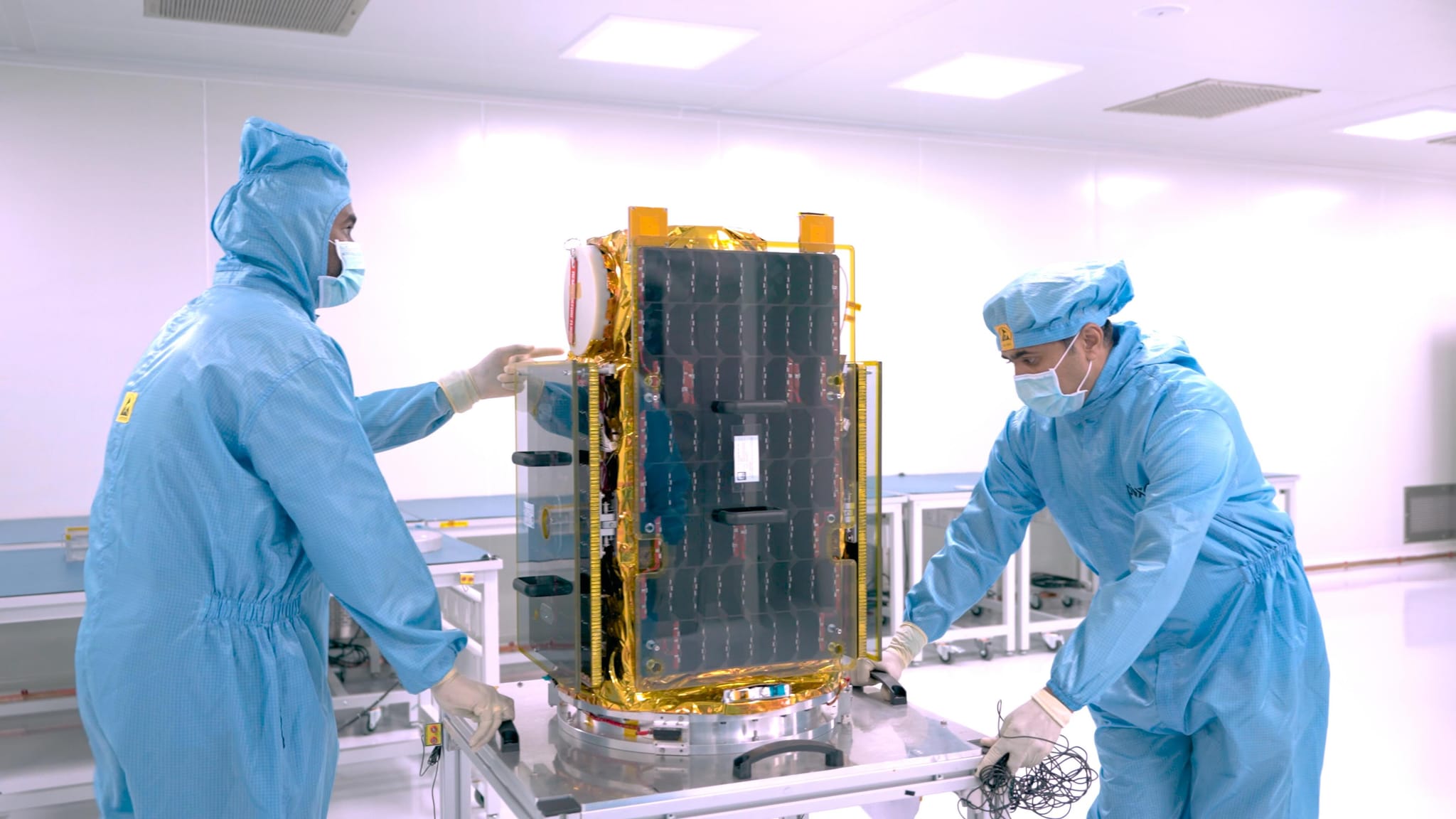
Firefly in Pixxel’s clean room before being shipped for launch.
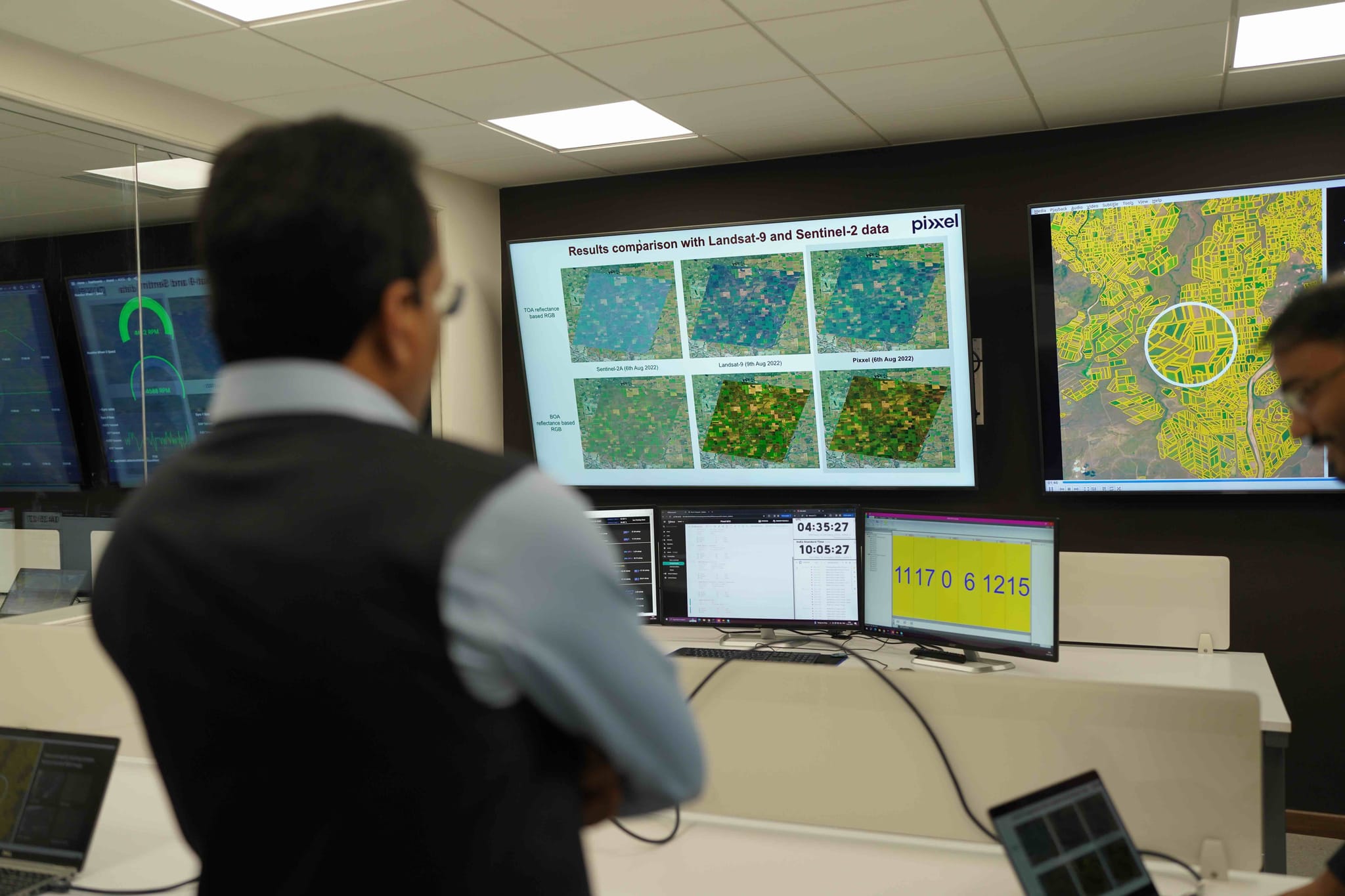
Shri S. Somanath, former Chairman, ISRO, reviewing hyperspectral imagery comparisons during a visit to Pixxel.
Early days at Pixxel, sketching what would become real. (Picture credits: Pixxel)
Pixxel Spacecraft Manufacturing Facility in Bengaluru. (Picture credits: Pixxel)
Pixxel team at Anand hyperspectral satellite launch event. (Picture credits: Pixxel)
Firefly in Pixxel’s clean room before being shipped for launch.
Shri S. Somanath, former Chairman, ISRO, reviewing hyperspectral imagery comparisons during a visit to Pixxel.
Due to launch delays, Anand finally reached orbit in November 2022 aboard ISRO's PSLV-C54, but not before Pixxel had already launched Shakuntala in April 2022 on a SpaceX Falcon-9. Shakuntala, named after the mother of Pawan and Vinay Sarda, literally meant "raised by birds.” Shakuntala became India's first hyperspectral pathfinder satellite and operated for 619 days, far exceeding expectations and proving that their hyperspectral technology worked.
The hard-fought success of Skyroot and Pixxel have paved the way for more than 300 space tech companies that have started since space was opened up to India’s private enterprise in 2020. Agnikul Cosmos is developing the Agnibaan rocket with 3D-printed engines, aiming for customizable orbital launches. GalaxEye is building multi-sensor satellites that combine synthetic aperture radar with optical imaging. Dhruva Space focuses on satellite platforms and ground systems, while Bellatrix Aerospace develops electric propulsion systems for satellites.
“I know that it's often hard to build something, but space is quite difficult. Taking it to a commercial scale and building a team around it is even harder,” says Hemant Mohapatra from Lightspeed, an early investor in Pixxel.
For traditional B2B SaaS investors and family offices to now scout for space-tech opportunities is a testament to the spirit that carried Sarabhai to Thumba, Kalam to the church-turned-lab, Somanath through Chandrayaan-3 while fighting cancer, and hundreds of young founders into garages and apartments to build rockets and satellites of their own.
Six decades after a Nike-Apache was wheeled out of a borrowed church on a bicycle, India’s spacefaring landscape looks unrecognizable—orbital docking, lunar landings, solar observatories, private rockets, hyperspectral constellations.
And yet the animating spirit hasn’t changed much. It’s still the same combination of scarcity and stubbornness, of young engineers who believe they can build something the world hasn’t seen before, of institutions learning to invent when they cannot import.
The church at Thumba is now a museum. The bicycle is behind glass. But the idea that carried them is very much alive. And in the hands of ISRO and a new generation of private dreamers, that idea is still finding new trajectories.
Edited by Prem Panicker
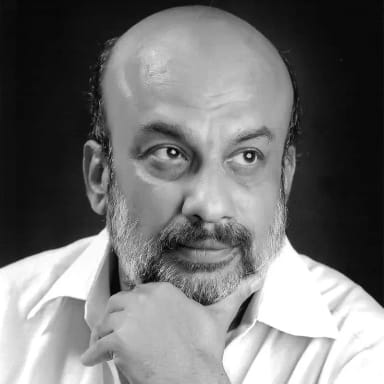
Prem Panicker is the editor of this volume and a pioneering figure in Indian digital journalism. A founding member of Rediff.com and former Managing Editor at Yahoo! India, he helped shape the country's early online news ecosystem. Now an independent writer and mentor, he focuses on narrative journalism and long-form storytelling, exploring how media, culture, and technology intersect in contemporary India.

Notes from Team Alter
This poster design is inspired by a 1976 Soviet Union (USSR) stamp depicting the Aryabhata satellite, a telling artifact of Cold War science diplomacy. At the time, India was navigating a careful non-aligned path between the United States and the USSR. The stamp quietly marked India’s arrival on the global scientific stage, carried forward by a world still divided, yet briefly aligned in orbit. This year marks the 50th anniversary of Aryabhata’s launch, and we’ve created a collectible to commemorate that iconic moment.
%2520(1).webp&w=3840&q=80&dpl=dpl_4Ddy3NjdpPoVv4q6xKoGwwTGME2t)
The team originally wanted to create a lenticular poster for this article. With tight deadlines and the sheer volume of work, we decided to hold off on a physical print for now. Instead, we created a digital lenticular-style visual that captures the same shifting perspective. Both images were conceived and built during an internal design hackathon. If you can guess the person we’re alluding to in the right half of the image, tweet your answer to @altermagindia.
Sparsh and Adithya stumbled upon the ₹2 note during a late-night call. A relic of the past, it was a fascinating piece of paper, and it had to find a place somewhere. Issued in 1976, the ₹2 Aryabhata note commemorates the moment India first touched space. It is a gentle reminder that even the smallest denominations can carry astronomical dreams. We’ve turned this into a printed postcard, which you can pick up when you visit us at IISc.
%2520(1).jpg&w=1920&q=80&dpl=dpl_4Ddy3NjdpPoVv4q6xKoGwwTGME2t)